I
genuinely thought that I had come up with an original blog post title. But a
quick Google search told me that it has been used by everyone from the New
Scientist to The Sun. A truly terrible blow to my ego...
Nonetheless,
we must find the strength to continue and discuss today’s topic: fracking.
What is
fracking?
Fracking, short
for hydraulic fracturing, involves drilling down into the earth and directing a
high-pressure water mixture at the rock to release the gas contained within it.
The high pressures at which water, chemicals and sand are injected into the
rock allows gas to flow out to the well’s head. The process is usually carried
out by drilling horizontally into a layer of rock, creating pathways to release
gas.
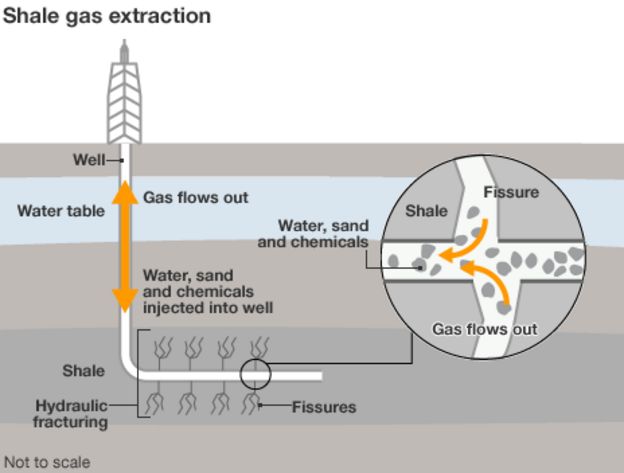 |
| The shale gas extraction process. Source: BBC |
What’s
happening in the UK?
Although
fracking has been commonplace in the North Sea oil and gas fields since the
1970s, the general public only became aware of the technique in 2007 when it
was proposed to be used for onshore shale gas wells.
Fracking has
been in and out of the press since then, with stories related to the latest
plans on where to drill and protests by environmental campaigners. The last
major news story related to fracking, in the news a couple of weeks ago, stated
that the new prime minister, Theresa May, would allow people who live near
shale gas exploration sites to be given cash payments of £20,000 so that they “benefit”
from the developments. This has led Shadow Energy Secretary Barry Gardiner to
accuse the prime minister of bribing people to make a decision which will not actually
benefit them.
 |
| Fracking protests have been taking place across the UK for years. |
Even though
shale gas drilling is only at an exploratory stage in the UK, large amounts of
controversy and debate have surrounded the mere thought of onshore fracking in
the UK. For example, in 2011, Cuadrilla suspended test fracking operations near
Blackpool after earthquakes of magnitude 1.5 and 2.2 hit the area. A study later
found it “highly probable” that the drilling process triggered these quakes.
There are
also concerns about fracking in areas of natural beauty and the detrimental
impacts this would have on northern landscapes where much of the UK’s gas
reserves lie. The British Geological Survey estimated that northern England has
1,300 trillion cubic feet of shale gas resources. With current UK gas consumption
at 2.5 trillion cubic feet a year, these reserves would keep us ticking over at
the same rate for 520 years. In January 2015, MPs pledged an “outright ban” on
fracking in national parks, but by December they voted to allow fracking at
1,200m below national parks, Areas of Outstanding Natural Beauty, the Norfolk
and Suffolk Broads and World Heritage Sites,
 |
| Shale gas reserves coincide with areas of natural beauty and National Parks in several areas. Source: BBC |
What’s
happened in other parts of the world?
There are
also cautionary tales from fracking operations in the U.S.A, many of which are
related to contaminated water. Although only roughly 2% of the water consists
of toxic chemicals, when billions of gallons of fluid are being used this
amounts to a significant amount of contamination. The oil and gas industry has
little knowledge of what to do with the contaminated water they are creating,
and fracking wastes and fluids have penetrated drinking water and aquifers
across several U.S. states, with a 2015 Environmental Protection Agency report
finding more than 150 cases of contamination.
Other issues
relate to air quality surrounding drilling sites and potential greenhouse gas
emissions. For example, Colorado has seen air pollution spikes in close
proximity to fracking wells and there is uncertainty as to how much methane is
being released to the atmosphere from the fracking process.
Lastly, and
perhaps most spectacularly, homeowners in fracking regions have reported being
able to light water coming out of their kitchen sinks on fire due to gas contamination
of their water supplies from fracking wells.
What are the
advantages of fracking?
After
reading all of those problems, you’re probably wondering why we are even
considering pursuing fracking as an option. Well of course, from an industrial
point of view there are advantages. The fracking process allows drilling
companies to access difficult-to-reach oil and gas reserves. In the U.S.A, oil
production has been significantly boosted and gas prices have fallen. The
process has potential to give the U.S.A and Canada gas security for about 100
years and could be used to generate electricity with half the carbon dioxide
emissions of using coal.
A similar story
could arise in the UK, with industry suggesting fracking of shale gas could contribute
significantly to future energy needs and thousands of jobs would be created by
allowing the process to proceed. Recent National Grid estimates state that
without shale gas extraction, the UK could be importing over 90% of its gas by
2040, so steps clearly need to be taken to increase energy supply security.
Overall, the
fracking debate looks likely to rumble on, with those that stand to benefit
from it facing a bitter battle with the general public and environmental
groups. The opposition’s environmental concerns are refuted by industry, who
say the process won’t have the speculated negative impacts if carried out
professionally.
Personally, however,
I am inclined to think that we should be concentrating our efforts and
incentives on renewable sources of energy, and ensuring a more secure energy future
through those methods rather ploughing more money into fossil fuels. The risks
of fracking just don’t seem worth it to me.
Til next time
Rob
Til next time
Rob

No comments:
Post a Comment